Porto and the North on the route of Nordic visitors
#NewsIn 2023, the Nordic countries (excluding Iceland, the Faroe Islands and Greenland) were Portugal's 8th largest market, and data shows that interest is growing. This is reflected in the increased demand for Porto and the North as a leisure destination for tourists from Sweden, Denmark, Finland and Norway.
Sweden in the global tourism market
With a population similar to Portugal (10.58 million in 2024), Sweden stands out for the solidity of its economy (24th largest in the world) and for being among the top 20 main outbound tourism markets worldwide (19th place, with a 1.2% share of total global tourism demand).
An even more relevant figure from the perspective of Porto and North is that 87.9% of outbound flows are concentrated in the European continent. Geographical location drives air travel, which accounts for 64.7% of the total. As for the top 10 destinations, it is led by Spain, with an 11.9% share, followed by neighbouring Denmark (8.7%), Germany (5.5%), the United Kingdom (4.5%), France (4.1%), Norway (3.3%), Italy (2.9%), the USA (2.5%), Turkey (2.5%) and Greece (2.4%). In 2024 Portugal ranked 16th, with a 1.0% share.
In this analysis of Sweden’s position in global tourism, other data also stand out:
- average global stay abroad was 7.2 days;
- more than half of foreign trips were made as a couple (36.8%) and as a family (28.3%);
- the age groups 35–49 (30.8%) and 50–64 (30.6%) dominate among Swedish tourists;
- 73.7% of total foreign trips made by Swedish residents were for leisure, including visits to friends and relatives; the share of business travel is still significant (18.5%).
Regarding seasonality, the distribution is quite balanced:
- 32.7% in high season
- 32.4% in low season
- 34.8% in mid‑season
Sweden market for Portugal
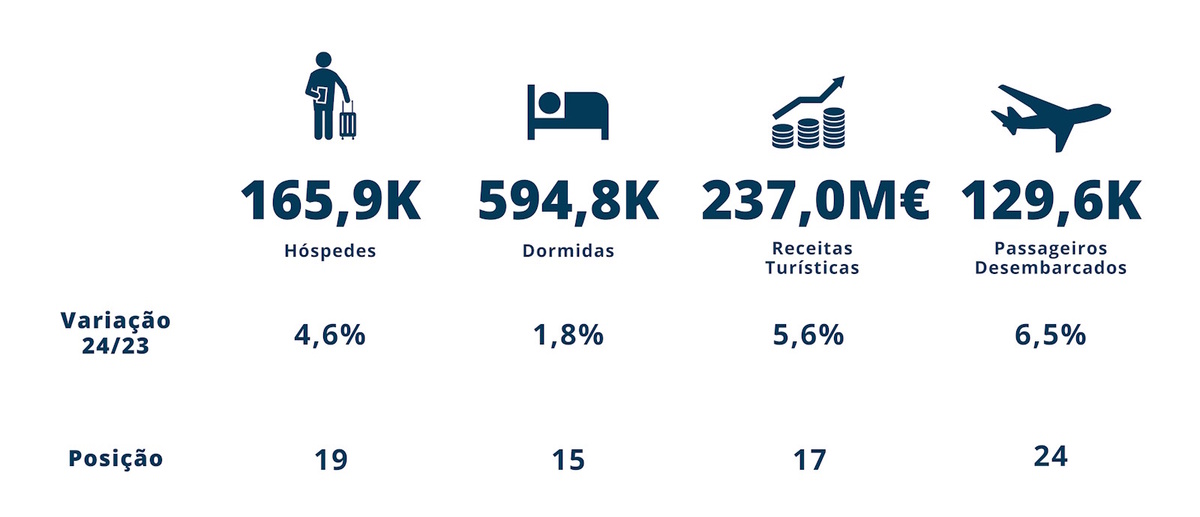
In total for 2024, Sweden was the 15th largest international tourism market for Portugal, with a 1.1% share in overnight stays and 19th place in guest numbers (0.9%).
The analysis of tourism revenues places the Swedish market in 17th place, with a 0.9% share. Compared to 2023, all indicators recorded growth.
Source: INE. Travel BI, Turismo de Portugal
An analysis of the period between 20 May 2024 and 18 May 2025 allows us to anticipate a growth rate of 3.5% and a share of 2.1%. During this period, 89,562 tourists travelled from Sweden to Portugal, placing our country in 13th position in total outbound air flows from the Swedish market.
In the same period, Porto was the city with the highest growth rate in the national market: it received 17,759 Swedish tourists, representing a 0.4% global share, but showing a growth rate of 22.4%. Although Lisbon is the most visited city by Swedish tourists travelling to Portugal, its growth rate was only 4.5%. In contrast, Faro received fewer tourists from Sweden during this period.
TAP Air Portugal is the most used airline (27.9% share), followed by SAS (21.1%), Ryanair (10.7%), Norwegian Air International (10.6%), KLM Royal Dutch Airlines (8.3%), Lufthansa (7.7%), among others. The vast majority of flights (77.3%) originated in the capital, Stockholm, followed by Gothenburg (19.4%) and a residual 3.3% from other cities.
The weight of leisure travel (83.4%) is very significant and shows clearly that Swedish tourists view Portugal as a holiday and relaxation destination, since only 16.6% came on business. Almost one third (32.3%) travel with another person and 27% in groups of 3 to 5 people (likely families). Even so, there is a significant share (21.3%) who travel alone. Trips in groups of more than 10 people represent 14% of the total.
More than half (51.9%) stay between 4 and 7 nights in Portugal, with a significant share staying two weeks (19.4%) and more than four weeks (11.5%).
Regarding booking lead time, the average is 74 days. The data highlight periods longer than 91 days (26.6%) and between 31 and 60 days (21.0%).
Between May 2024 and May 2025, 62.5% of plane tickets were purchased directly; almost 30% were acquired online.
Prospects
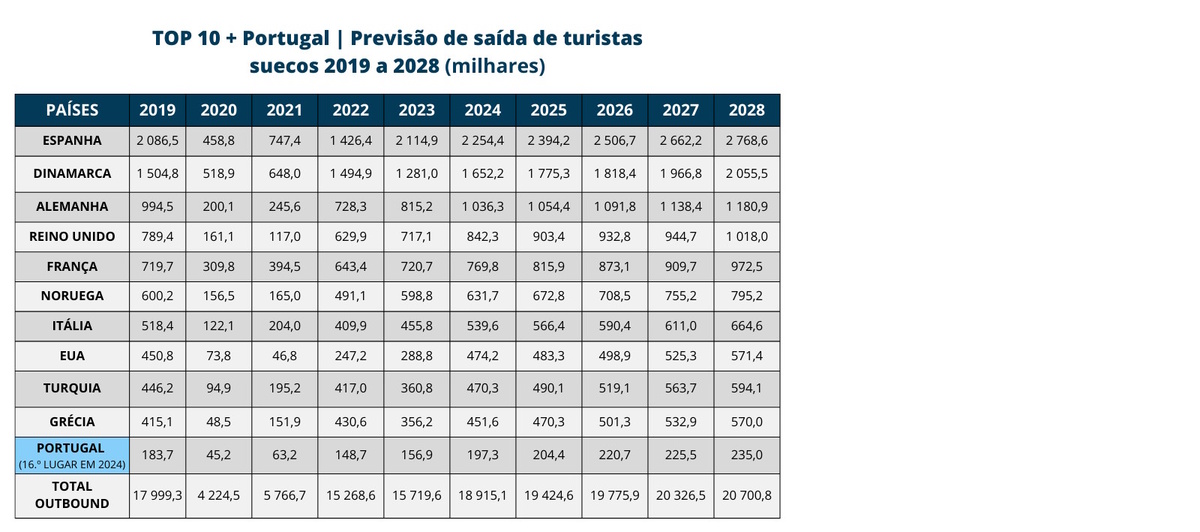
After the recession in 2023, the Swedish economy resumed growth, which should translate into an increase in the number of international tourists. GlobalData forecasts 20.7 million departures in 2028, along with increases in spending.
For Portugal, GlobalData forecasts 235,000 Swedish tourists in 2028.
Source: GlobalData
Denmark in the global tourism market
Denmark was, in 2024, the 26th largest outbound tourism market worldwide, with a 0.8% share. With around six million inhabitants in 2024, the Nordic country was responsible for 12.4 million foreign trips (an 8.8% increase compared with the previous year and 5.1% above pre‑pandemic levels).
Source: INE. Travel BI, Turismo de Portugal
92% of trips were to Europe, with the main destinations being:
- Sweden (22.6%)
- Germany (13.8%)
- Spain (10.6%)
- Italy (8.1%)
- United Kingdom (5.8%)
- France (5.0%)
- Norway (3.8%)
- Austria (3.5%)
- Greece (2.8%)
- Turkey (2.7%)
That year, Portugal ranked 13th with a 1.4% share — a number expected to be surpassed in 2025.
According to the data, the profile of Danish tourists can be outlined as follows:
- Family travel is most frequent (33.6%), followed by couples (28.3%), groups (20%) and solo trips (18.1%)
- Average stay abroad was 7.1 days
- 25.1% were aged 50–64 and 20.2% aged 15–24
- 82.7% of trips were for leisure; 14% were for business
- Low season (Jan, Feb, Mar, Nov, Dec) accounts for 39.8% of trips, followed by mid‑season (31.6%) and then high season
In 2024, Danish tourist spending increased 12.5% year‑on‑year, exceeding 2019 levels by +40.72%. Average per‑trip spending was €179.14 (USD 206.4).
In global outbound spending, Denmark ranked 33rd (0.7% share). Transport accounted for the largest share (37.9%), above accommodation (20.5%) and restaurants (12.7%).
Denmark market for Portugal
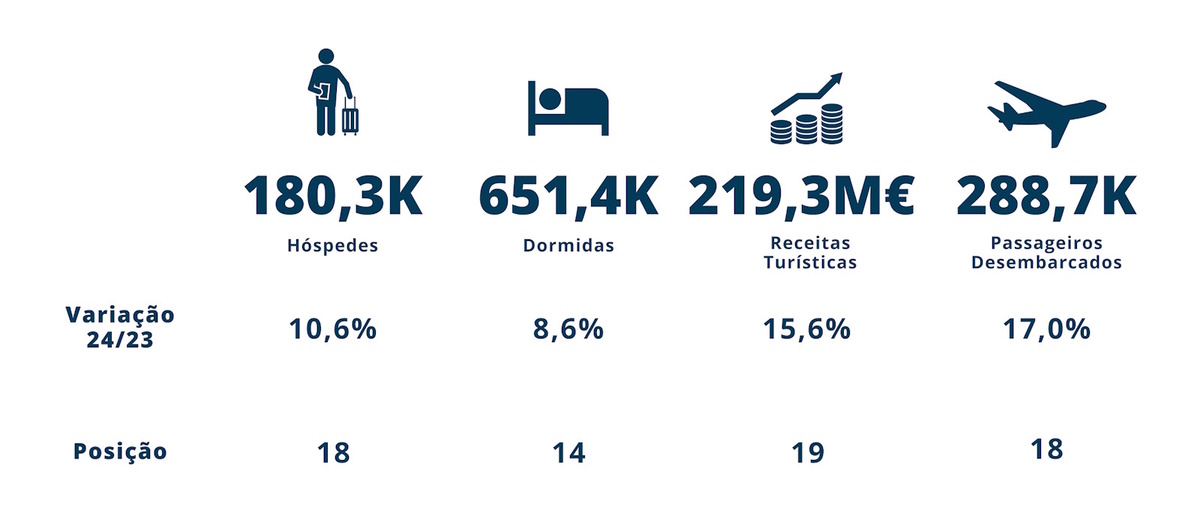
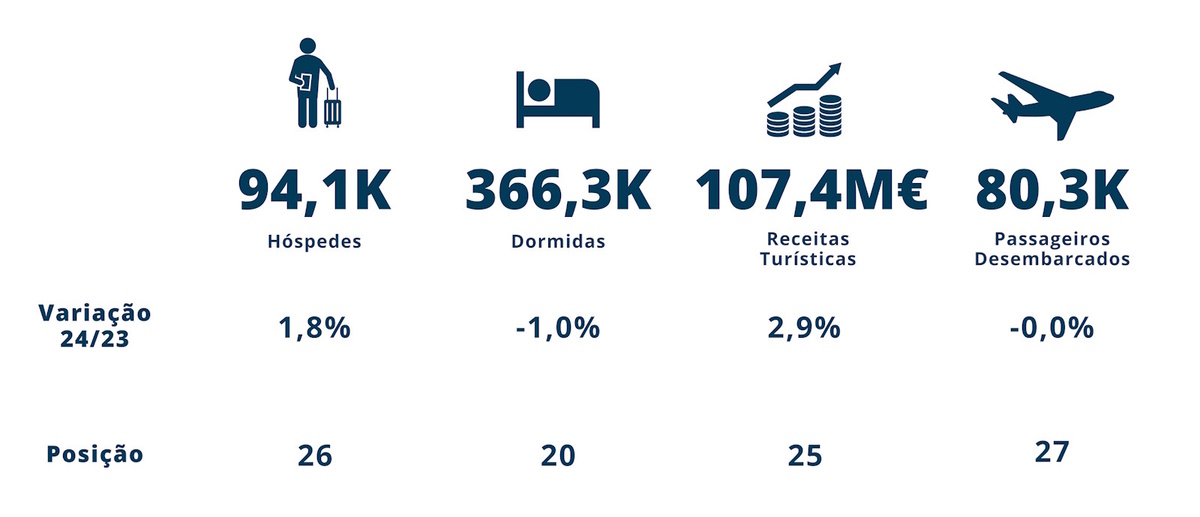
In 2024, Denmark ranked as the 14th international tourism market for Portugal (1.2% share in overnight stays). It ranked 18th in guest numbers (0.9%) and 19th in tourism revenues (0.8%). All indicators rose between 2023 and 2024, with double‑digit growth in guests, revenues and passengers.
For the period 20 May 2024 to 18 May 2025, the results are even more positive: Portugal ranked 10th in outbound air flows from Denmark, with a growth rate of 1%, a share of 2.7% and 123,790 tourists.
Lisbon and Porto were the cities with the highest growth rates, with increases of 7.9% and 7.3%, respectively. Travel to the islands recorded significant declines.
TAP Air Portugal (27.3%), Ryanair (20.4%) and Norwegian Air International (17.4%) were the airlines bringing most tourists to Portugal. Most flights departed from Copenhagen (79.4%), followed by Billund (14.5%), Aarhus (6.7%) and Aalborg (3.3%).
Leisure (92.8%) is clearly the main motivation for Danish visitors. When they do visit, they stay an average of 12 nights. Almost half (46.5%) stay between 4 and 7 nights; 16.2% stay for around two weeks; and 13.2% for more than two weeks.
Travel as a pair (30.8%) and in small groups of 3 to 5 (29.2%) account for more than half of trips. Nearly 20% travel alone and 13.5% in groups of more than 10 people.
Bookings are made with an average lead time of 61 days, and tickets are purchased mainly directly and online.
Prospects
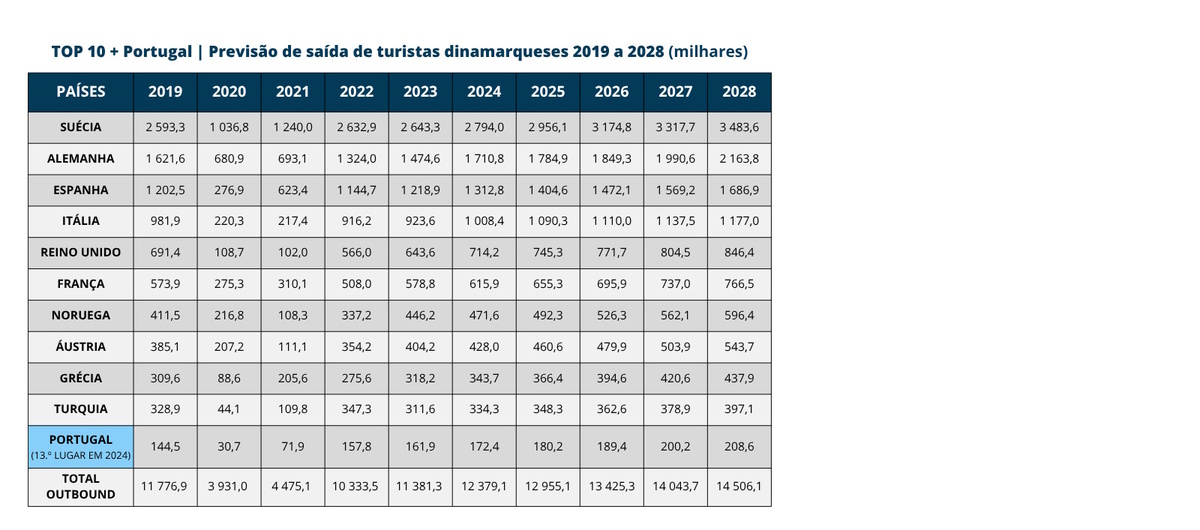
Growth in the Danish economy will be reflected in outbound tourism. By 2028, 14.5 million departures are expected, a 3.8% increase in trips and 7.3% increase in spending.
In 2025, around 180,000 Danes are expected to travel to Portugal (well above pre‑pandemic levels), with steady growth anticipated over the next three years.
Source: GlobalData
Finland in the global tourism market
With just 5.61 million inhabitants, Finland was the world’s 45th largest economy in 2024 and 12th in the European Union. That year, foreign leisure travel increased 18.5% year‑on‑year, although still slightly below pre‑pandemic levels.
Total foreign spending grew 24.2% but was still below 2019 levels (-3.5%).
With 9.1 million trips, Finland ranked 35th among global outbound markets, representing a 0.7% share of global tourism demand.
As in the other Nordic countries, most trips (94.9%) were by air and went to Europe:
- Sweden (19.8%)
- Estonia (13.2%)
- Spain (8.8%)
- Germany (3.9%)
- Greece (2.9%)
- France (2.8%)
- United Kingdom (2.7%)
- Poland (2.6%)
- Denmark (1.9%)
- Norway (1.8%)
Portugal ranked 14th, with a 1.2% share.
Key figures defining the Finnish tourist profile:
- average global stay abroad: 6.9 days
- group travel has the largest share (29.5%)
- followed by couples (26.8%), families (26.6%) and solo trips (17.1%)
- 26.5% aged 35–49; 22.8% aged 50–64
- 74.1% leisure travel; 21.8% business
Finland market for Portugal
Demand for Portugal is growing among Finnish tourists, according to data from 27 May 2024 to 25 May 2025.

Source: INE. Travel BI, Turismo de Portugal
During this period, Portugal received 64,995 Finnish tourists, placing the country 13th among outbound air flows from Finland, with a growth rate of 8.1% and a 1.2% share.
The highest growth rate occurred in Faro (the opposite of other Nordic tourists), tied with Porto at 84th place among visited cities. Still, Porto received more Finns than Faro, but both recorded lower numbers than Lisbon or Funchal.
Finnair, with a 71.7% share, was the main airline, followed by TAP Air Portugal in fourth place (4.6%), behind Lufthansa (8.0%) and Sunclass Airlines (5.5%).
Helsinki was the origin of 93.9% of flights, followed by Oulu, Kuopio and others (1.0%). 93.9% also reflects the percentage of Finns who travel to Portugal for leisure; only 6.7% come for business.
Average stay in Portugal was 9.3 nights. Most tourists (60.1%) stay between 4 and 7 nights, with 20.4% staying for two weeks.
20% of Finns travel alone to Portugal, but there is a clear preference for travelling as a pair (39.6%) or in groups of 3 to 5 (26.0%).
Reservations are made an average of 87 days in advance. Almost one-third (32.3%) book more than three months ahead, and only 13.4% book with less than 15 days remaining.
Distribution channels show a preference for direct booking (82.9%).
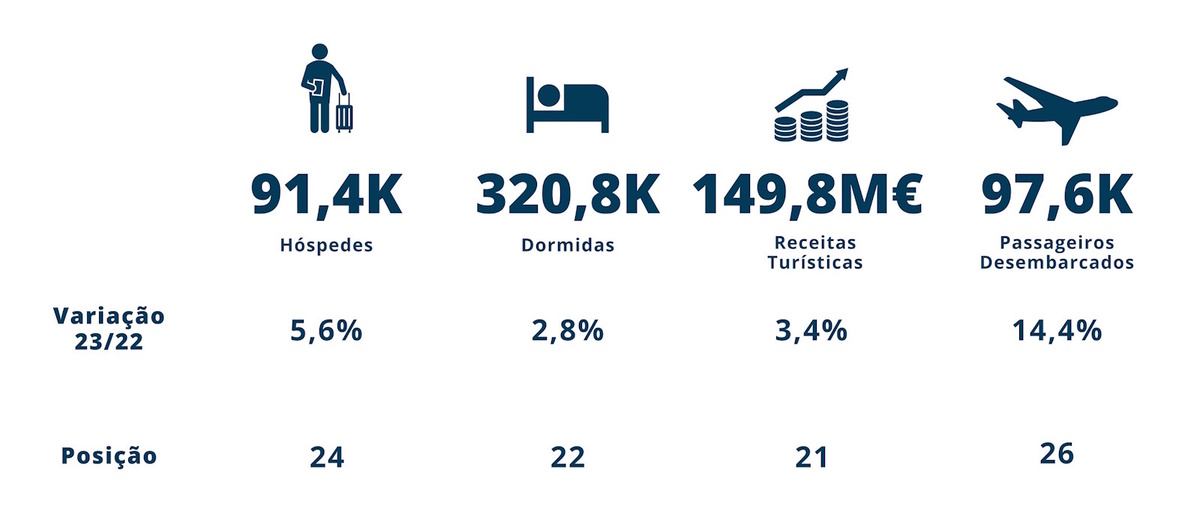
Between 2024 and 2023, guests and revenues increased, but overnight stays decreased, with passenger numbers unchanged.
Source: INE. Travel BI, Turismo de Portugal
Prospects
The Finnish economy has been in recession due to conflicts in Ukraine and the Middle East, rising energy costs and other raw materials and intermediate goods, but 2025 should mark a reversal of this trend.
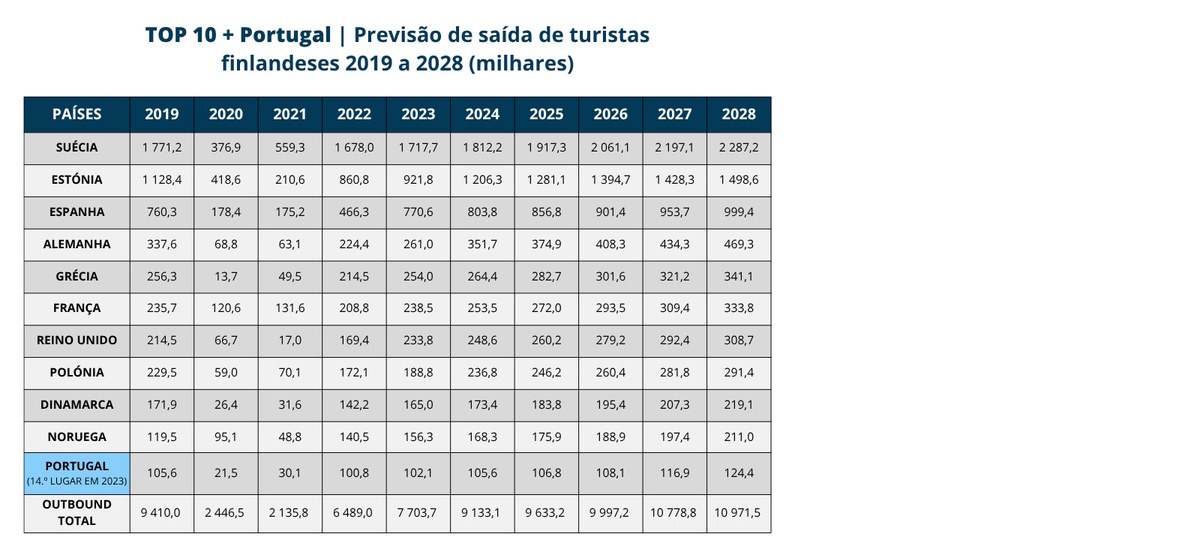
As a result, international departures by Finnish tourists are expected to grow around 64.4%, reaching 11 million by 2028, according to GlobalData.
Foreign spending is also expected to increase by around 9%.
Portugal should also benefit from this positive context, with over 106,000 Finnish tourists expected this year.
Source: GlobalData
Norway in the global tourism market
Norway was, in 2023, the world’s 31st largest economy and the second largest in Scandinavia, with GDP growth above Sweden and Denmark.
In tourism terms, it ranked 30th as an outbound market, corresponding to a 1.2% share of global tourism demand. In that year, foreign trips by Norwegian tourists grew 9.6% (10.4 million trips), but were still 9.7% below 2019 pre‑pandemic levels.
As with other Nordic countries, most foreign travel (93.3% of outbound flows) was to Europe:
- Sweden (18.9%)
- Spain (14.5%)
- Denmark (11.7%)
- United Kingdom (6.5%)
- Poland (3.6%)
- Greece (3.5%)
- Germany (3.3%)
- France (3.1%)
- Italy (2.0%)
- Turkey (2.0%)
Portugal ranks 15th, with a 0.9% share.
Key characteristics of Norwegian tourists:
- average stay abroad: 7 days
- 32.7% of trips are made by couples; 25.0% by families; 23.4% by solo travellers; 18.8% by groups
- 31.1% travel in high season, between July and September
- 23.4% are aged 50–64; followed by 35–49 (20.2%) and 15–24 (15.9%)
- 65.9% travel for leisure; 19% for business
Norway market for Portugal
The most recent data available (3 November 2023 to 10 November 2024) indicates that 68,205 Norwegian tourists travelled to Portugal during that period, representing a 1.8% share and a growth rate of 13.6%.
During this period, Porto was the city with the highest growth rate (+31.8%), receiving 13,300 tourists. Lisbon remains the most popular national destination, while Faro saw a 5.2% drop in demand, receiving 11,541 tourists.
TAP Air Portugal (36.5%), Norwegian Air Shuttle ASA (23.9%) and KLM Royal Dutch Airlines (17.8%) form the top three airlines. Oslo (74.9%) is the main point of departure, followed by Stavanger (7.9%) and Bergen (7.7%).
Travelling mainly for leisure (92.3%), Norwegian tourists stay an average of 10.9 nights in Portugal. Stays of 4 to 7 nights are the most common (43.6%), followed by two‑week stays (25.6%).
Regarding group size, there is balance between solo travel (27.3%), travel by two people (29.3%) and groups of 3 to 5 (28.2%).
Advance booking is another characteristic of Norwegian tourists: one‑third book more than three months in advance. Ticket purchases are mainly online.
Despite positive evolution, revenues, guests and overnight stays remain below pre‑pandemic levels.
Source: INE. Travel BI, Turismo de Portugal
Prospects
Norway's economy is expected to strengthen this year, which may lead to growth in outbound tourism: forecasts indicate that by 2028, 15.1 million departures will be reached — including over 115,000 Norwegian tourists travelling to Portugal. Trips to all European destinations, including Portugal, will increase, surpassing pre‑pandemic levels.
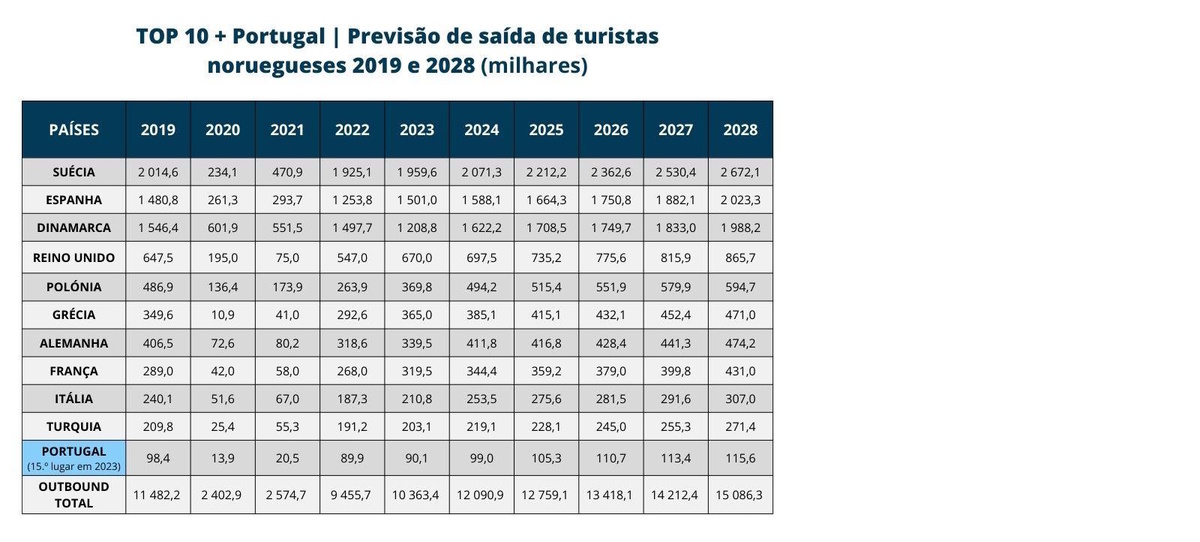
Source: GlobalData
What Nordic tourists look for ?
Despite natural differences, tourists from the Nordic countries share characteristics that allow a sufficiently precise profile to be drawn for the creation of strategies to attract this market:
- High purchasing power
- Frequent international travel
- Investment in quality experiences in accommodation, gastronomy and cultural activities
- Preference for sunny and warm countries
- Interest in outdoor activities such as golf, hiking, cycling and water sports
- Strong focus on sustainability, with environmentally respectful accommodation and activities
- Interest in local culture and historical sites
- Limited interest in typically tourist‑oriented attractions
Read too...
Talk to us...
Should you have any questions or for any further information, please do not hesitate to contact us.

Porto Convention & Visitors Bureau is a non-profit organization founded in 1995 by a group of institutions that wanted to develop the Tourism Industry in Porto and Northern Portugal.