A path with over a thousand years of history
#NewsThe route to Santiago de Compostela is perhaps the oldest, most traveled, and most celebrated in all of Europe. It stems from faith and human curiosity, but also from the desire for encounter—with oneself, with others, with the transcendent. But success is not always easy to manage, and there are challenges that arise for which it is important to find answers, bringing together public and private entities.
The Portuguese reality
The Portuguese Way of St. James is experiencing a moment of affirmation. More and more pilgrims are choosing this route for its authenticity, its diversity of landscapes, and the human warmth they encounter along the way. This growing popularity is, without a doubt, good news — a sign of the Way’s value as a tourist, economic, and cultural asset. But it also brings new challenges that must be addressed with realism and planning.
Demand for the Way has been growing very significantly, especially between May and October, reflecting its enormous power of attraction. This success, however, brings new challenges: the need to reinforce infrastructure and services to respond to increasingly intense demand.
At certain times, the high occupancy of accommodation and rising prices make planning more demanding, both for pilgrims and for the professionals who work along the Way. For tourism entertainment companies, the challenge lies in ensuring timely bookings and maintaining the quality standards required by the destination.
Local communities also feel the impact of this growth, which reinforces the importance of balanced management of the territory and public services, in order to preserve the authenticity and hospitality that have always distinguished the Way.
Balance requires better management of flows and installed capacity, so as to preserve what makes the Way so special: tranquility, contact with communities, and an authentic experience. Regulating, rather than restricting, seems to be the guiding principle.
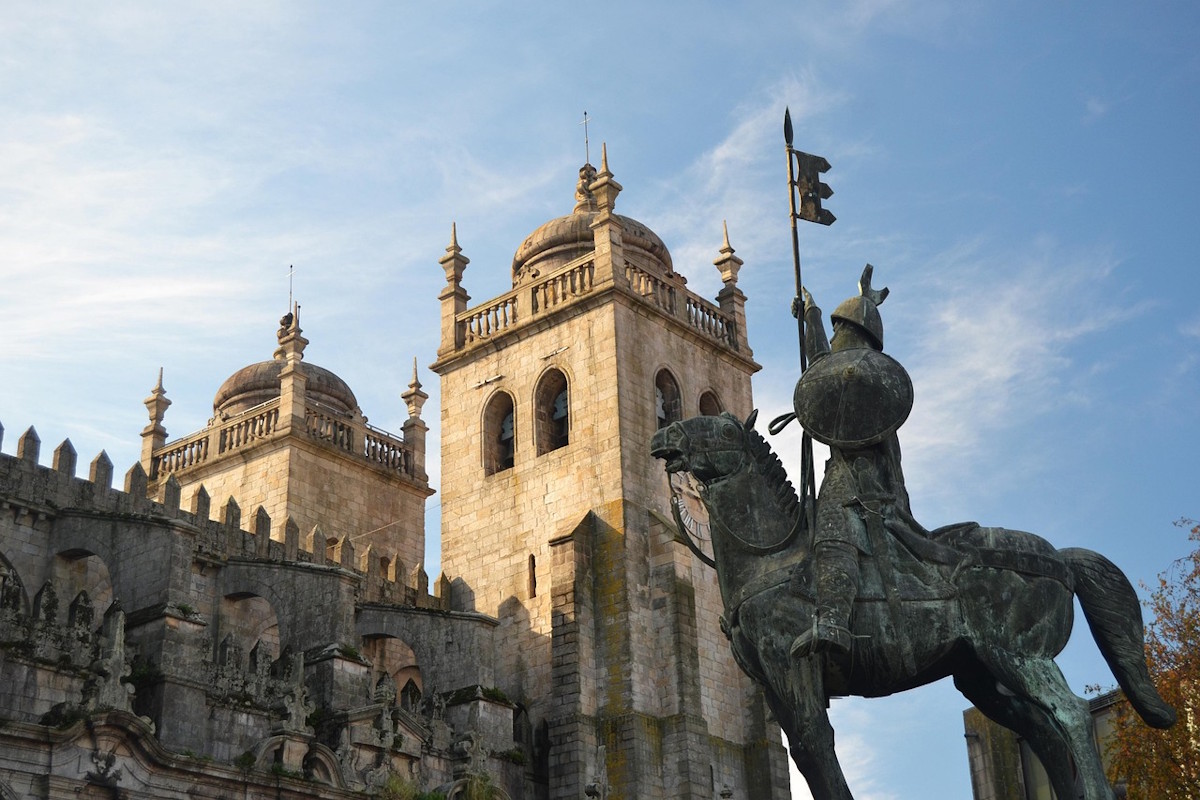
Porto, Cathedral of Sé. © DR
The private sector, municipalities, and public entities have here an opportunity for cooperation — more than continuing to promote the Way, it is time to take care of it, ensuring quality, sustainability, and good conditions for everyone who is part of it. This sometimes implies ensuring such basic conditions as having enough toilets to meet demand.
Because the Portuguese Way of St. James is much more than a route: it is a symbol of encounter and sharing, and a gateway to discovering the best of Portugal and Galicia. Growing with balance is the challenge, but also the key to ensuring that this human and cultural heritage remains alive and inspiring for future generations.
For this to happen, measures must be taken to ensure that the Way does not lose its shine:
- A sustainable management approach is essential — regulating the number of visitors, educating for environmental respect, and preserving historical heritage are decisive steps. The use of digital technologies can enrich the pilgrims’ experience without compromising the authenticity of sacred places;
- It is also fundamental to involve local communities, so that tourism becomes a source of balanced development and keeps alive the soul of the Way. Diversifying the offer, with cultural, gastronomic, and wellness proposals, can help attract new audiences and distribute flows across the territory.
Some numbers
Official data provided by the Oficina del Peregrino show a constant growth in the number of pilgrims over the past two decades, except for the pandemic years:
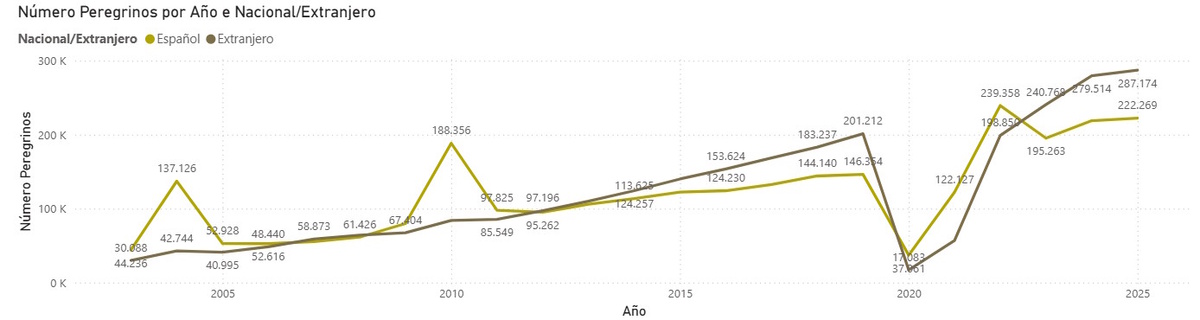
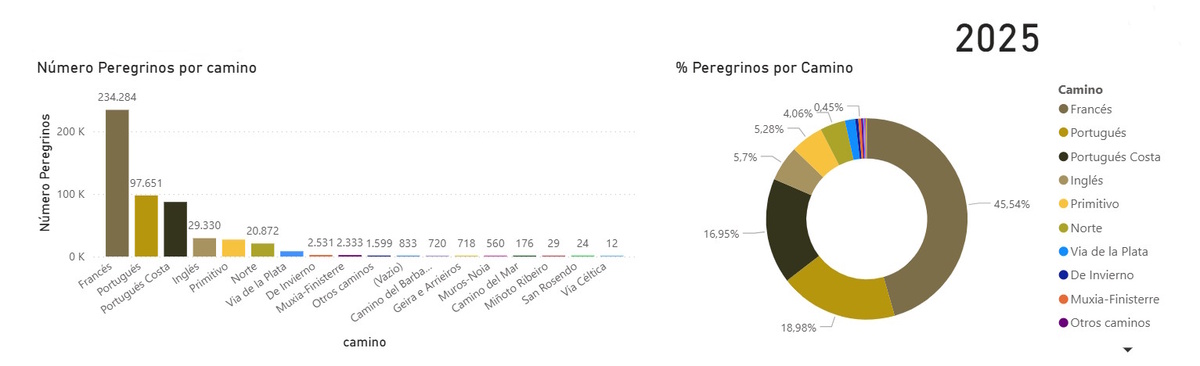
Thus, in 2025, by the end of October, we reached more than 514,000 pilgrims, already surpassing the total for 2024 (499,177). Regarding the different Ways, the French, the Portuguese, and the Portuguese Coastal Way make up the top 3 most sought-after:
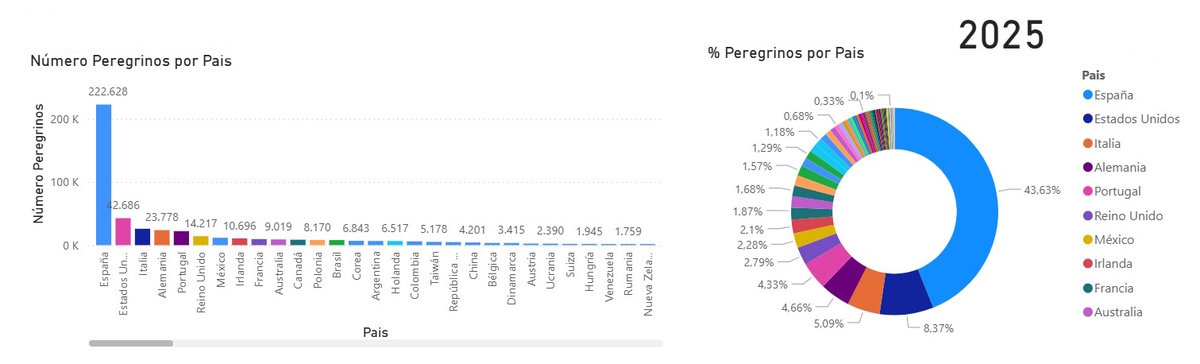
And if we look at the origin of these tourists, Spain stands out with 222,628, followed by the United States (42,686), Italy (25,966), Germany (23,778), and Portugal (22,101):
Portuguese Way
In 2024, the Portuguese Way of St. James recorded 95,495 pilgrims, an increase of around 7.6% compared to 2023, when 88,729 were counted. This growth reinforces the position of the Portuguese Way as one of the most relevant itineraries in this context.
The number of Spanish pilgrims rose from 31,734 to 35,120, representing 37% of the total, while pilgrims from other nationalities increased from 55,936 to 60,369, confirming the growing international attractiveness of this route.
Among the main source markets in 2024, Spain (36.8%), Portugal (12.8%), and the United States (7.3%) stand out, followed by Germany and Italy. These data show a strong presence of Iberian pilgrims but also strong interest from outside Europe, especially the North American market, which continues to grow consistently.
Although the total number of pilgrims has increased, the relative share of the Portuguese Way among all Ways of St. James slightly decreased from 49.71% in 2023 to 47.36% in 2024, indicating faster growth in other routes, such as the French or the Primitivo. Still, the data for 2024 reflect a trajectory of consolidation and dynamism, with the Portuguese Way asserting itself as one of the most sought-after and diverse routes in terms of pilgrims’ origin.
Portuguese Coastal Way
In 2024, the Portuguese Coastal Way received 74,754 pilgrims, a substantial increase of around 41.7% compared to 2023, when 52,757 were recorded. This growth confirms the rapid rise of this route as one of the most dynamic and in-demand.
The number of Spanish pilgrims rose from 11,750 to 15,700, representing 21% of the total, while pilgrims of other nationalities increased from 40,418 to 59,052, reinforcing the international nature of this route.
Among the main source markets in 2024 are Spain (21%), Germany (11.6%), and the United States (11.2%), followed by Italy and Portugal. These figures show a strongly international profile, with European predominance but also a significant presence of North American pilgrims, confirming the global expansion of the Portuguese Coastal Way.
Despite a slight reduction in its relative share among the various Ways, the absolute increase in pilgrims demonstrates the strong expansion of this Atlantic route, which is increasingly establishing itself as a popular alternative to the Central Way, standing out for its scenic appeal, coastal identity, and geographical diversity of walkers.
If we now look at the economic impact, 2023 data indicate that the economic impact generated by the 123,800 pilgrims who in 2022 walked the two certified Portuguese Ways — the Central and the Coastal — amounted to around 16 million euros. Researcher Melchor Fernández, author of the study, stated to journalists after the presentation of the document (resulting from the cross-border cooperation project "Facendo Caminho") that this amount corresponded to 6% of the total economic impact generated by the 438,000 pilgrims who arrived in Santiago de Compostela that year.
Another study, conducted by the University of Santiago de Compostela in 2021, showed that the economic impact of the Way in Galicia exceeded 280 million euros per year, benefiting especially sectors such as hospitality and catering.
On demand
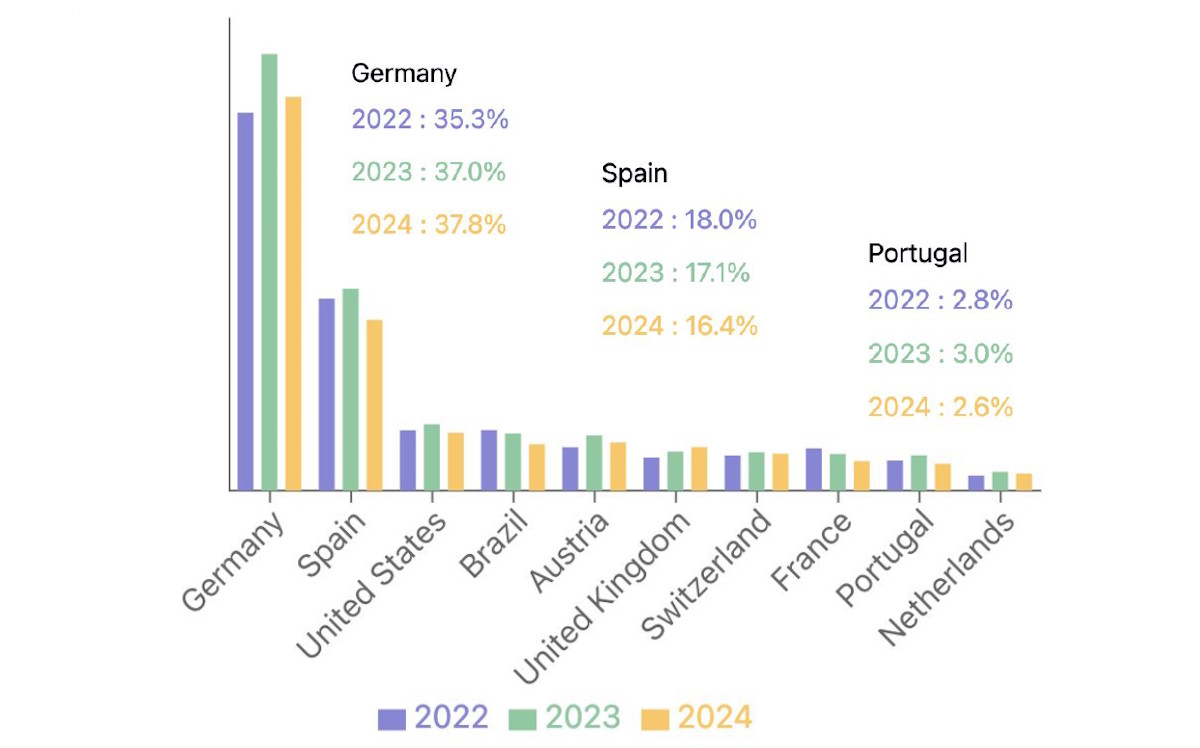
In a document prepared by the Caetsu agency, it is interesting to observe some behaviors from the consumer side of the Ways, starting with understanding in which countries most searches for the Ways of St. James are made:
Source: bloom-consulting.
Source: bloom-consulting
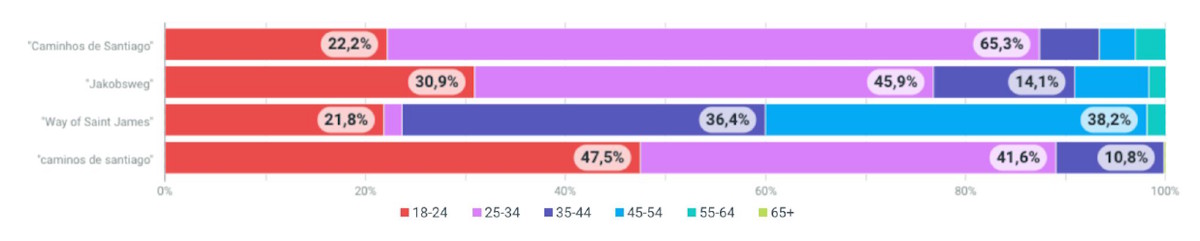
When the parameter is age group, it is noteworthy that in Spain younger people show greater interest in the Ways:
Source: bloom-consulting
“O Camino Que Nos Une”: a new step together
Barcelos hosted, on December 13, 2024, the first International Congress “O Camino Que Nos Une”, which strengthened cooperation between Porto and North Tourism and Galicia Tourism within the framework of the Euroregion Tourism Cluster.
The meeting brought together experts and decision-makers to reflect on the sustainable management of the Way of St. James, the preservation of its heritage, and the importance of innovative promotion strategies.
Luís Pedro Martins, president of TPNP, emphasized at the time that the priority is “to have a joint strategy to develop until 2030, based on products with the greatest capacity for internationalization, with special focus on the Ways of St. James, seeking initiatives that add value to the product.”
Five Ways, one destination
Since the 9th century, when the tomb of the apostle St. James the Greater is said to have been discovered in Galicia, multiple routes began to be traced towards Compostela. Ways of faith and encounter, of culture and heritage, spanning centuries and borders, connecting peoples, languages, and beliefs. In Porto and Northern Portugal, the heart of Portuguese Jacobean identity, five official itineraries lead pilgrims to Santiago: the Coastal Way, the Central Way, the Interior Way, the Torres Way, and the Minho–Ribeiro Way. Each has its own landscape, legends, and rhythm — all united by the same spirit of pilgrimage and discovery.
Way of St. James. © DR
1. Coastal Way – 138 km of sea and memory
From Porto to Valença, the Coastal Way travels through lands of sea and salt, history and hospitality: Matosinhos, Vila do Conde, Esposende, Viana do Castelo, Caminha. Here, pilgrims are accompanied by the sound of the waves and the warmth of the people. It is said that it was on Bouças beach — the former name of Matosinhos — that the miraculous encounter between the “Knight of the Shells” and the boat carrying the apostle’s body took place, giving rise to the scallop shell as the Jacobean symbol. The route crosses territories linked to the Order of the Knights Hospitaller, who, from the Monastery of Leça do Balio, welcomed pilgrims and kings on their way to Santiago.
2. Interior Way – 214 km of authenticity and endurance
From Viseu to Chaves, passing through Lamego, Peso da Régua, and Vila Real, the Interior Way is a challenge to body and soul. Among the valleys and terraces of the Douro, vineyards and olive groves, the pilgrim finds the silence of the mountains and the strength of tradition. Considered the oldest long-distance pilgrimage route in Portugal, of medieval origin, it crosses 108 parishes and offers landscapes of exceptional beauty. It is also one of the five itineraries proposed for UNESCO World Heritage recognition.
3. Central Way – 178 km of faith and living heritage
It is the most traveled route in Portugal, linking Oliveira de Azeméis to Porto and then to Valença, passing through manor houses, estates, and villages that preserve the heartbeat of the North. Here, the Way intersects past and present — from the Church of Rates, where the first Bishop of Braga converted by St. James rests, to the vibrant historic centers of Barcelos and Ponte de Lima. It was along this route that the first modern pilgrim hostel in Portugal was created, a symbol of the hospitality that continues to distinguish the Central Way.
4. Torres Way – 234 km of spirituality and art
Named in honor of the writer and pilgrim Diego de Torres Villarroel, this itinerary crosses the historical and artistic heart of the country, from Sernancelhe to Valença. Along six cathedrals and four UNESCO World Heritage sites, the Torres Way leads travelers through stunning landscapes and Baroque towns such as Amarante and Braga. It is also a route of profound devotion: in Sernancelhe one finds the oldest sculpture of the apostle St. James in Portugal, and in the old hostels and monasteries the history of Jacobean hospitality is revived.
5. Minho–Ribeiro Way – 123 km of nature and tradition
Starting in Braga, ancient Bracara Augusta, the Minho–Ribeiro Way crosses the green heart of Minho, passing through Ponte da Barca, Arcos de Valdevez, Monção, and Melgaço before reaching Galicia. Pilgrims walk Roman trails and rural paths among hills and vineyards, passing Celtic settlements, thermal springs, and ancient monuments. Here, nature, thermalism, and wine blend into a sensory and spiritual journey that celebrates the most authentic roots of the northwestern Iberian culture.
Five Ways, five ways of living the same spirit. Five routes that, starting from Porto and Northern Portugal, continue to lead thousands of pilgrims towards Santiago — between the sacred and the human, between the past and the present, always with eyes set on the horizon.
To support pilgrims with information, Porto and North Tourism organizes and provides extensive online resources, with guidance on the Ways, what to do, where to go, useful information, etc. The Xunta de Galicia does the same through its dedicated Camino website.
A journey of faith, culture, and encounter across the centuries
Since the 9th century, as already mentioned, Galicia has become a pilgrimage destination that attracted kings, monks, and the faithful from all over Europe. Thus Compostela was born, one of the great spiritual centers of Christianity, alongside Rome and Jerusalem.
During the Middle Ages, the Way became a symbol of faith, culture, and hospitality — welcoming the pilgrim meant welcoming Christ himself. Despite the wars and crises that marked the following centuries, devotion kept the Jacobean flame alive.
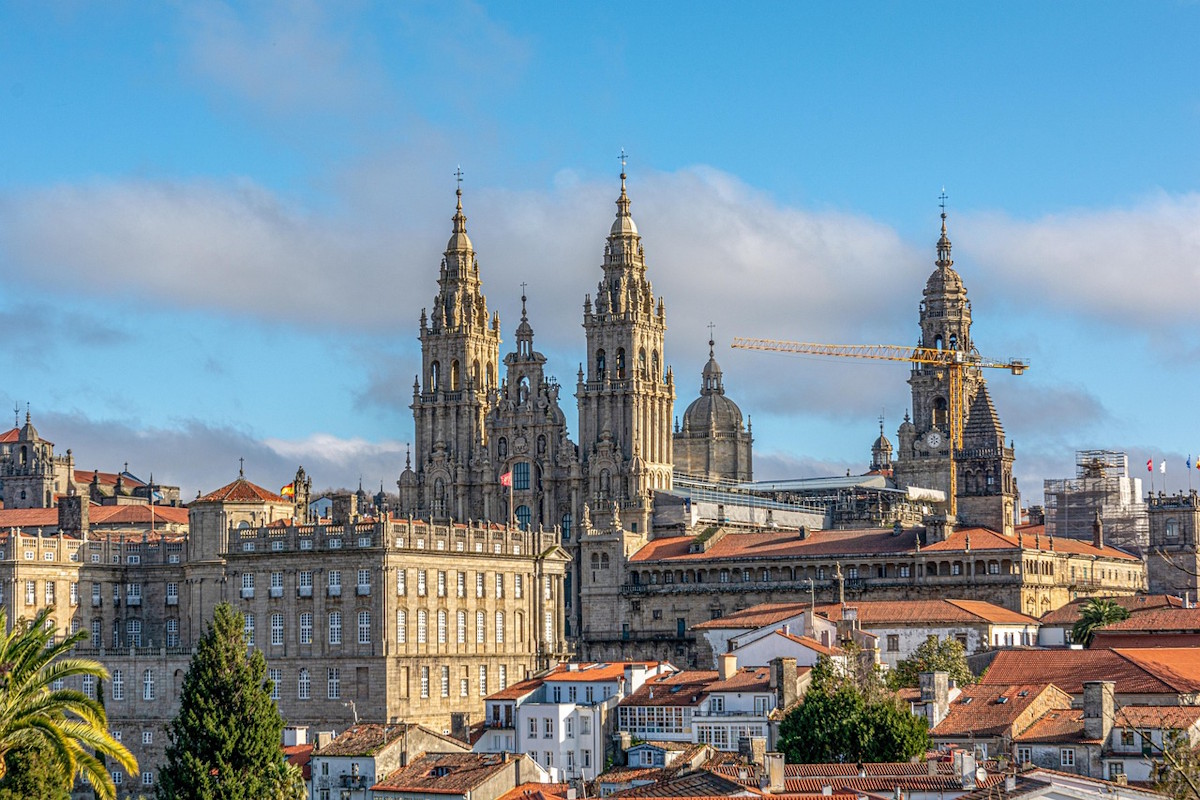
Santiago, Cathedral. © DR
Rediscovered in the 19th century and revitalized in the 20th century, the Way of St. James is today much more than a route of faith: it is an inner and outer journey, a universal heritage that continues to unite people, cultures, and generations. In Porto and Northern Portugal, the Way finds one of its most authentic and inspiring gateways.
Did you know…? Curiosities about the Way of St. James
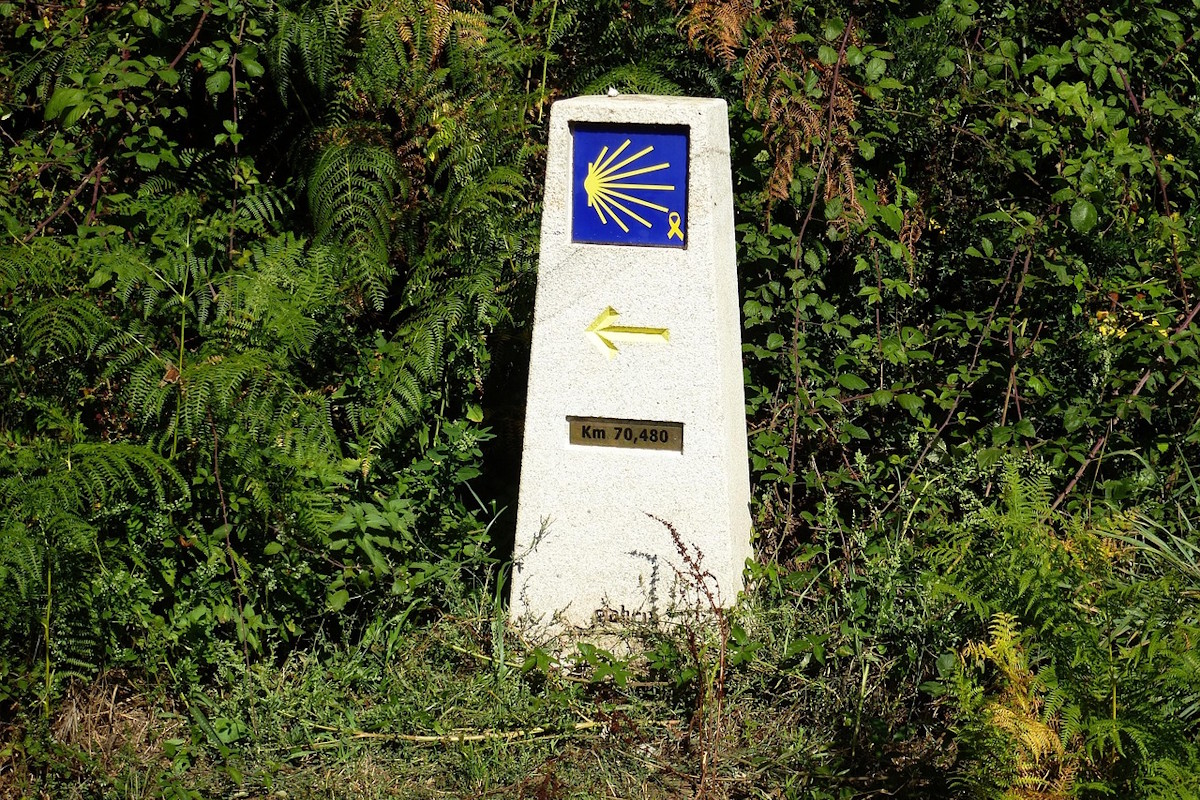
🔸 The yellow arrow — Today one of the most universal symbols of the Way, the yellow arrow was created in 1984 thanks to Father Elías Valiña, known as the priest of O Cebreiro. Paintbrush in hand, he marked the entire route from France to Santiago, making life easier for thousands of pilgrims.
🔸 The scallop shell — Long before the arrow, the scallop shell was already the pilgrims’ emblem. In the 12th century, the Codex Calixtinus already mentioned it as a Jacobean symbol. Historically, it could only be purchased in Santiago as proof that the pilgrimage had been successfully completed. The neighborhood of Concheiros in Compostela was born precisely from the artisans who sold these shells.
🔸 The credential and the Compostela — To sleep in hostels and obtain the Compostela, the certificate that attests the pilgrimage, the pilgrim credential is required, which must be stamped at each stage. It is issued to those who walk at least 100 km on foot or horseback, or 200 km by bicycle.
🔸 A Way for everyone — The Way of St. James is increasingly inclusive. Between 2021 and 2022, 127 wheelchair users completed the route thanks to ongoing efforts in adaptation and accessibility. A proof that the spirit of the Way is truly within everyone’s reach.
And it is also in this way, with hands and wills united, that the Way will continue to be a symbol of encounter, sharing, and hope.
Read too...
Talk to us...
Should you have any questions or for any further information, please do not hesitate to contact us.

Porto Convention & Visitors Bureau is a non-profit organization founded in 1995 by a group of institutions that wanted to develop the Tourism Industry in Porto and Northern Portugal.